Federal Criminal Investigation: Target, Subject or Witness?
Understanding your role as a target subject witness federal investigation participant can change how you respond to prosecutors, agents, subpoenas, or requests for testimony. In a federal criminal investigation, being called a witness is not the same as being a subject, and being a subject is not the same as being a target.
These labels can affect your legal risk, your response strategy, whether you should speak with investigators, and how quickly you should involve a defense attorney. Even if you have not been arrested or charged, your status in a federal investigation should be taken seriously.
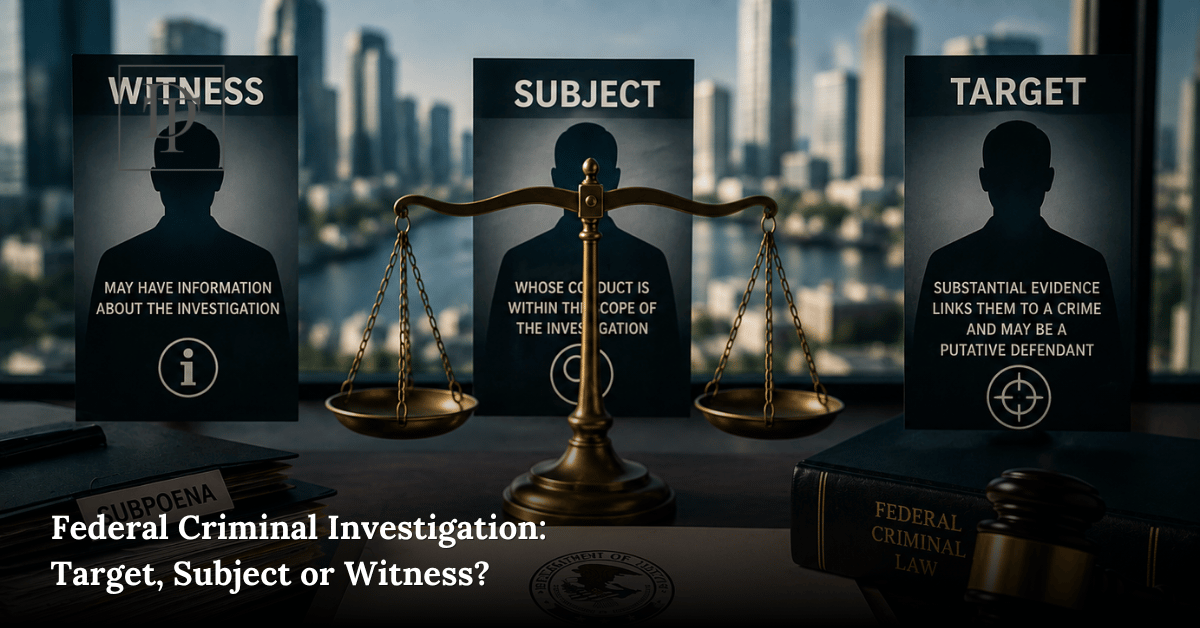
The Department of Justice uses these terms in grand jury investigations. A “target” is generally someone prosecutors or the grand jury have substantial evidence linking to a crime and who may be considered a putative defendant. A “subject” is someone whose conduct is within the scope of the investigation.
At Dustin Tischler Law, we represent clients facing white collar crime charges in Miami, federal investigations, subpoenas, target letters, fraud allegations, RICO matters, and serious criminal defense concerns.
Target Subject Witness Federal Investigation: Why Your Status Matters
In a target subject witness federal investigation, your status helps show how federal prosecutors may view your connection to the case.
A witness may have information.
A subject may have conduct under review.
A target may be closer to possible charges.
The problem is that people do not always know which category they fall into. You may receive a subpoena, a call from federal agents, a request for documents, or a target letter without fully understanding how prosecutors view your role.
Your status may also change as the investigation develops. Someone who starts as a witness may later become a subject. A subject may later become a target if prosecutors believe the evidence supports possible charges.
That is why it can be risky to assume you are “just helping” the government.
What Is a Witness in a Federal Investigation?
A witness is usually someone who may have information relevant to the investigation. A witness may have seen something, handled records, worked at a company, communicated with a person under investigation, or participated in events prosecutors are reviewing.
A witness may be asked to:
- Speak with federal agents
- Provide documents
- Testify before a grand jury
- Explain business records
- Identify people, accounts, or transactions
- Authenticate emails, invoices, or communications
Being a witness does not automatically mean you are suspected of wrongdoing. However, a witness can still face risks. If you make a false statement, guess about facts, omit important context, or testify inaccurately, you may create new legal problems.
A witness should be especially careful when the investigation involves their own conduct, their employer, their business partners, financial records, or communications that could be interpreted in different ways.
What Is a Subject in a Federal Investigation?
A subject is more serious than a witness. According to the DOJ’s grand jury guidance, a subject is a person whose conduct is within the scope of the grand jury’s investigation.
This does not necessarily mean prosecutors have decided to charge you. But it does mean your actions, decisions, records, communications, or financial activity may be part of what the government is investigating.
You may be considered a subject if investigators are reviewing:
- Business transactions you handled
- Emails or text messages you sent
- Financial records connected to you
- Company decisions you approved
- Payments, wires, or invoices involving your name
- Your role in an alleged conspiracy
- Your connection to a broader fraud, RICO, or white collar investigation
A subject should not casually speak to federal agents or prosecutors without legal advice. What seems like an innocent explanation may later be compared against documents, witness statements, bank records, emails, or grand jury testimony.
What Is a Target in a Federal Investigation?
A target is the most serious of the three categories. The DOJ describes a target as someone for whom prosecutors or the grand jury have substantial evidence linking them to the commission of a crime and who, in the prosecutor’s judgment, is a putative defendant.
If you are a target, prosecutors may already be considering charges. You may receive a target letter, be asked to testify, be contacted by agents, or learn that a grand jury is reviewing evidence connected to you.
A target letter may warn that:
- You are a target of a federal investigation
- The grand jury is investigating possible federal criminal violations
- You have the right to remain silent
- Anything you say may be used against you
- You should consult with an attorney
- Destruction or alteration of documents can create additional legal problems
The DOJ’s sample target letter also warns that destroying or altering documents required before the grand jury may violate federal law, including obstruction of justice.
If you are identified as a target, you should not contact prosecutors or agents on your own.
How Federal Investigators May Categorize You
Federal investigators and prosecutors may look at many factors when deciding whether someone is a witness, subject, or target.
They may consider:
- Your role in the events under investigation
- Whether you controlled money, accounts, or records
- Whether you approved transactions
- Whether you communicated with other people involved
- Whether records show knowledge or intent
- Whether witnesses mention your name
- Whether you benefited financially
- Whether your conduct appears accidental, negligent, or intentional
- Whether you appear to be part of a larger scheme
These categories are not always fixed. As investigators collect more evidence, your status may change.
If the investigation involves phones, accounts, messages, financial records, or online activity, the defense may need to review digital evidence in criminal cases.
Why You Should Not Guess Your Status
One of the biggest mistakes people make in a federal investigation is assuming they are only a witness because they have not been arrested.
You may still be at risk if:
- Agents ask detailed questions about your conduct
- You receive a subpoena for your own records
- Prosecutors ask about your intent
- Your business or employer is under investigation
- You are asked about financial transactions
- Co-workers or associates have been contacted
- You receive a target letter
- You are asked to testify before a grand jury
A federal investigation can move quietly for months before charges are filed. By the time someone receives a subpoena or target letter, prosecutors may already have records, witness statements, financial data, digital evidence, or grand jury testimony.
Common Cases Involving Witnesses, Subjects, and Targets
The target, subject, and witness distinction can appear in many federal cases.
Common investigations include:
- Wire fraud
- Mail fraud
- Bank fraud
- Healthcare fraud
- Medicare billing investigations
- Money laundering
- Tax allegations
- Embezzlement
- RICO and conspiracy
- Cybercrime
- Drug conspiracy
- Public corruption
- Corporate investigations
If prosecutors are reviewing financial records, business documents, invoices, wires, or alleged fraud, the case may overlap with federal fraud and white collar defense in Miami.
If investigators are trying to connect multiple people or transactions to a broader alleged scheme, the case may also involve RICO and conspiracy defense in Miami.
What You Should Not Do If Federal Agents Contact You
Whether you believe you are a witness, subject, or target, you should be careful about how you respond.
Avoid:
- Speaking to agents without legal advice
- Guessing answers
- Minimizing your role without reviewing records
- Deleting emails, texts, files, or accounting records
- Contacting witnesses or co-defendants
- Trying to coordinate stories
- Altering invoices, ledgers, or business documents
- Posting about the investigation online
- Ignoring subpoenas or official notices
Even a person who begins as a witness can create exposure by making false, incomplete, or inconsistent statements.
How a Defense Attorney Can Help Clarify Your Role
A defense attorney may be able to contact prosecutors, review the documents, evaluate the subpoena or letter, and assess whether you appear to be a witness, subject, or target.
Depending on the case, counsel may:
- Communicate with the U.S. Attorney’s Office
- Clarify your status when possible
- Review subpoenas or target letters
- Preserve records
- Prepare you for interviews or testimony
- Evaluate Fifth Amendment concerns
- Review privilege issues
- Investigate facts before charges are filed
- Challenge the government’s assumptions
- Develop a response strategy
If you have received a subpoena connected to federal grand jury proceedings, the issue may overlap with a grand jury subpoena response strategy.
If you received a formal notice that you are a target, the case may also connect with federal target letter Miami defense concerns.
Federal Investigations in Miami: Local Defense Considerations
Federal criminal investigations in Miami may involve the U.S. Attorney’s Office for the Southern District of Florida, federal grand juries, and agencies such as the FBI, IRS, DEA, HHS-OIG, Homeland Security Investigations, or other federal authorities.
These investigations may involve local businesses, healthcare providers, financial institutions, international transactions, digital records, corporate documents, or alleged multi-person schemes.
Dustin Tischler Law is located in Downtown Miami and represents clients facing federal investigations, subpoenas, target letters, fraud allegations, RICO matters, white collar investigations, and serious criminal accusations throughout Miami-Dade County.
Speak With a Miami Federal Defense Attorney

If you have been contacted by federal agents, received a subpoena, received a target letter, or learned that your conduct is under investigation, do not guess your status. The difference between witness, subject, and target can affect your rights, your risks, and your defense strategy.
Dustin Tischler Law represents clients involved in federal criminal investigations in Miami and throughout South Florida. If you need help understanding where you stand in a federal investigation, contact the firm as soon as possible.
If you received a federal target letter, contact Dustin Tischler Law as soon as possible to discuss your situation and begin preparing a defense strategy.