What Is a Pattern of Racketeering Activity in a Florida RICO Case?
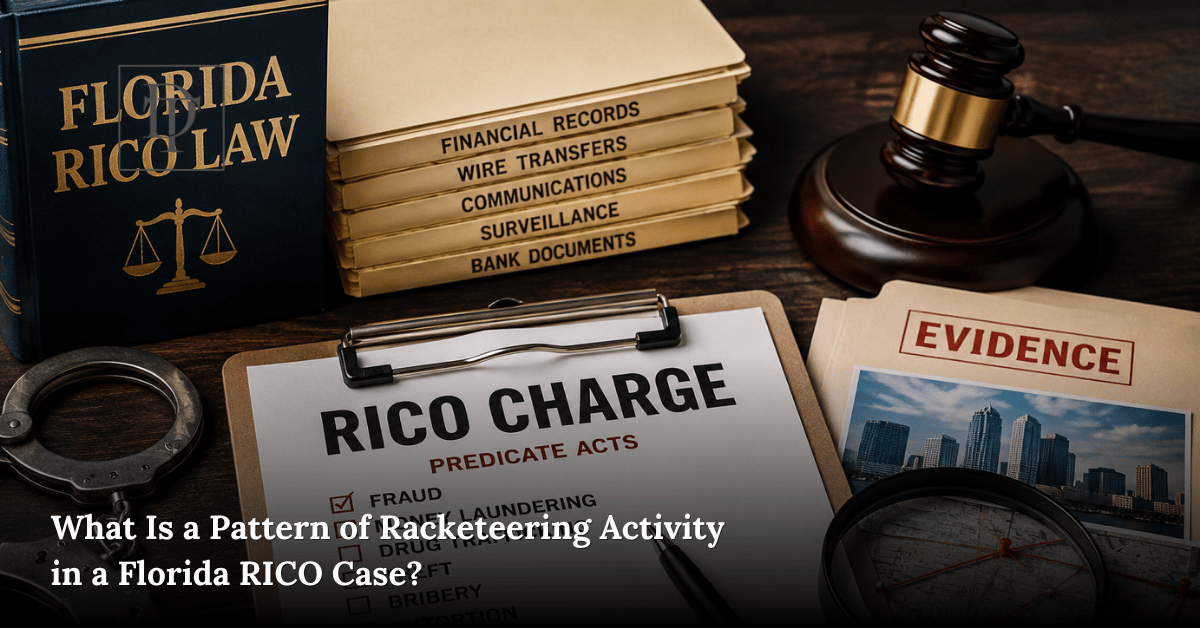
Florida RICO predicate acts are the underlying crimes prosecutors may use to support a RICO charge. In other words, a Florida RICO case is not built on the word “racketeering” alone. Prosecutors must usually point to specific criminal acts and argue that those acts are connected to a broader pattern of racketeering activity.
This matters because not every criminal accusation qualifies as a RICO case. The prosecution must connect the alleged conduct to Florida’s RICO statute, show that the acts fall within the law’s definition of racketeering activity, and prove that the conduct is tied to an enterprise or unlawful pattern.
At Dustin Tischler Law, we defend clients facing RICO and conspiracy defense in Miami by challenging weak predicate acts, disputed connections, unreliable evidence, and overbroad prosecution theories.
Florida RICO Predicate Acts: What Are They?
In a Florida RICO case, a predicate act is an underlying offense that prosecutors claim qualifies as racketeering activity. Florida Statute 895.02 defines “racketeering activity” to include committing, attempting to commit, conspiring to commit, or soliciting, coercing, or intimidating another person to commit certain listed offenses.
The statute includes a wide range of possible offenses, but the key point is this: the alleged act must legally qualify as racketeering activity under the statute. Prosecutors cannot simply label conduct as “organized crime” or “racketeering” without connecting it to a qualifying offense.
A defense attorney may challenge whether the alleged conduct is actually a qualifying predicate act, whether the evidence supports the accusation, and whether the prosecution is trying to stretch a normal criminal case into a RICO case.
How Predicate Acts Connect to a Pattern of Racketeering Activity
Predicate acts matter because Florida RICO cases usually require more than one isolated incident. Florida law defines a “pattern of racketeering activity” as at least two incidents of racketeering conduct that share similar intents, results, accomplices, victims, methods, or other interrelated characteristics and are not isolated incidents. The last incident must occur within five years after a prior incident of racketeering conduct.
This means prosecutors may try to connect multiple alleged acts into one larger theory. For example, they may argue that several transactions, communications, thefts, fraud claims, or financial movements were not separate events but part of an ongoing scheme.
The defense may respond by asking:
- Are the alleged acts truly connected?
- Do they involve the same purpose or method?
- Are the same people involved?
- Are the alleged victims or results similar?
- Is there evidence of a continuing scheme?
- Or are prosecutors combining unrelated events to create the appearance of a RICO pattern?
This is often one of the most important battlegrounds in a Florida RICO case.
Common Crimes That May Support a Florida RICO Charge
Florida’s RICO statute lists many categories of racketeering activity. The specific offense matters, but prosecutors commonly build RICO cases around financial, violent, drug-related, fraud-related, or organized conduct.
Examples may include:
- Theft and robbery
- Fraudulent practices
- Money laundering or financial transaction offenses
- Drug trafficking or drug distribution
- Computer-related crimes
- Bribery or misuse of public office
- Perjury or obstruction-related offenses
- Witness tampering or retaliation
- Forgery or counterfeiting
- Burglary or trespass
- Certain weapons or firearms offenses
- Human trafficking or related offenses
- Medicaid fraud or public assistance fraud
- Securities or investment-related violations
Florida Statute 895.02 specifically references categories such as theft, robbery and related crimes; computer-related crimes; fraudulent practices; bribery; obstruction of justice; drug abuse prevention and control; and offenses related to financial transactions.
Fraud and Financial Crimes as RICO Predicate Acts
Many Florida RICO investigations involve alleged financial misconduct. Prosecutors may claim that multiple transactions, invoices, claims, payments, transfers, or business records show a broader racketeering pattern.
Fraud-related predicate acts may appear in cases involving:
- False invoices
- Investment schemes
- Insurance fraud
- Patient brokering
- Healthcare billing issues
- Credit card fraud
- Business record manipulation
- Real estate or timeshare allegations
- Financial transaction offenses
- Money laundering
If the case involves financial records, business documents, billing, or alleged deceptive transactions, it may also overlap with white collar crime charges in Miami.
A key defense issue is whether the records actually show criminal intent or whether prosecutors are misinterpreting business activity, compliance mistakes, accounting issues, or ordinary transactions.
Drug, Firearms, and Violent Crime Predicate Acts
RICO is sometimes used in cases involving alleged drug organizations, violent groups, weapons offenses, or coordinated criminal activity. The prosecution may argue that separate acts are connected because they involve the same people, purpose, methods, or alleged enterprise.
Potential predicate acts may include:
- Drug trafficking or distribution
- Firearms-related offenses
- Robbery
- Assault or battery
- Burglary
- Witness intimidation
- Retaliation against witnesses or victims
- Obstruction-related conduct
Florida’s RICO statute includes Chapter 893 offenses involving drug abuse prevention and control, Chapter 790 offenses involving weapons and firearms, Chapter 812 offenses involving theft and robbery, and Chapter 784 offenses involving assault and battery.
If the case involves alleged drugs or distribution, the defense may connect with drug crimes in Miami.
If the accusation involves force, threats, robbery, or assault allegations, the case may also involve violent crime charges in Miami.
Computer-Related Crimes and Digital Evidence
Florida RICO cases can also involve digital evidence. Prosecutors may rely on phone extractions, emails, social media messages, IP records, cloud data, financial platforms, encrypted chats, or computer records to argue that several acts were connected.
Florida Statute 895.02 includes Chapter 815 computer-related crimes as potential racketeering activity.
That does not mean every digital record proves a RICO case. A message, login, spreadsheet, app record, or online payment may be taken out of context. The defense may need to challenge:
- Who controlled the account
- Whether the data is complete
- Whether timestamps are accurate
- Whether messages are being misread
- Whether the accused knew about the alleged scheme
- Whether the records actually show criminal participation
If the case involves computers, online accounts, phone data, or electronic communications, it may overlap with cybercrime charges in Miami.
Predicate Acts Are Not the Whole RICO Case
Even if prosecutors identify qualifying predicate acts, that does not automatically prove a RICO charge. The government still has to connect those acts to the broader legal requirements of the case.
Florida Statute 895.03 prohibits certain conduct involving the use or investment of proceeds from a pattern of racketeering activity, acquiring or maintaining an interest in an enterprise through a pattern of racketeering activity, participating in an enterprise through a pattern of racketeering activity, or conspiring to violate those provisions.
That means the defense may challenge several layers of the case:
- Whether the alleged acts qualify as predicate acts
- Whether there are at least two qualifying acts
- Whether the acts form a true pattern
- Whether an enterprise existed
- Whether the accused participated in the enterprise
- Whether the accused had criminal intent
- Whether prosecutors are relying on association instead of proof
A RICO case can look overwhelming because it may include many records, people, and allegations. But the prosecution must still prove each required element.
How a Defense Attorney Challenges Florida RICO Predicate Acts
A strong defense does not treat every alleged act as automatically valid. Each predicate act should be examined separately before accepting the prosecution’s larger RICO theory.
A defense attorney may ask:
- Does the alleged act legally qualify under Florida Statute 895.02?
- Is there evidence the accused committed, attempted, conspired, solicited, coerced, or intimidated someone to commit the act?
- Is the act supported by reliable records or testimony?
- Are prosecutors relying on another person’s conduct?
- Is the evidence being taken out of context?
- Does the act connect to the alleged enterprise?
- Does the act connect to the other alleged acts?
- Is the state trying to inflate a smaller case into a RICO prosecution?
In some cases, the defense may be able to weaken the RICO theory by attacking the predicate acts. If the underlying acts are unsupported, unrelated, or legally insufficient, the larger RICO charge may become vulnerable.
Florida RICO Subpoenas and Predicate Act Investigations
Predicate act investigations may begin before a person is charged. Florida Statute 895.06 allows investigative agencies, when they have reason to believe a person or enterprise has engaged in activity violating the chapter, to subpoena witnesses or material and collect evidence. The statute also provides confidentiality rules for certain subpoenas.
If you receive a subpoena, records request, or investigator contact related to a possible RICO investigation, do not assume it is routine. The government may be collecting evidence to identify predicate acts, connect transactions, or build an enterprise theory.
You should not delete records, alter documents, contact witnesses, or speak informally with investigators without legal advice.
Speak With a Miami RICO Defense Attorney
Florida RICO cases can involve many alleged predicate acts, multiple people, years of records, and complex theories about enterprises or conspiracies. But the prosecution cannot rely on volume alone. It must prove that the alleged acts qualify under the statute and connect to a legally sufficient RICO theory.
Dustin Tischler Law represents clients facing RICO, conspiracy, white collar, fraud, drug, cybercrime, and serious criminal investigations in Miami and throughout South Florida. If prosecutors are trying to connect multiple allegations into a RICO case, early defense work can help challenge weak predicate acts and protect your rights.
Contact Dustin Tischler Law to discuss the allegations and begin evaluating your defense.