Federal Drug Conspiracy Charges in Miami: How These Cases Work
Federal drug conspiracy charges can expose a person to severe criminal penalties even when the government’s case does not look like a traditional drug arrest.
There may be no drugs found in the defendant’s home. No controlled substances may have been discovered in the defendant’s vehicle. The person may never have been present during a particular shipment, sale, or seizure.
Instead, federal prosecutors may build a conspiracy case around an alleged agreement involving multiple people and use phone records, text messages, financial transactions, surveillance, cooperating witnesses, intercepted communications, travel records, or other evidence to argue that a defendant knowingly joined a plan to violate federal drug laws.
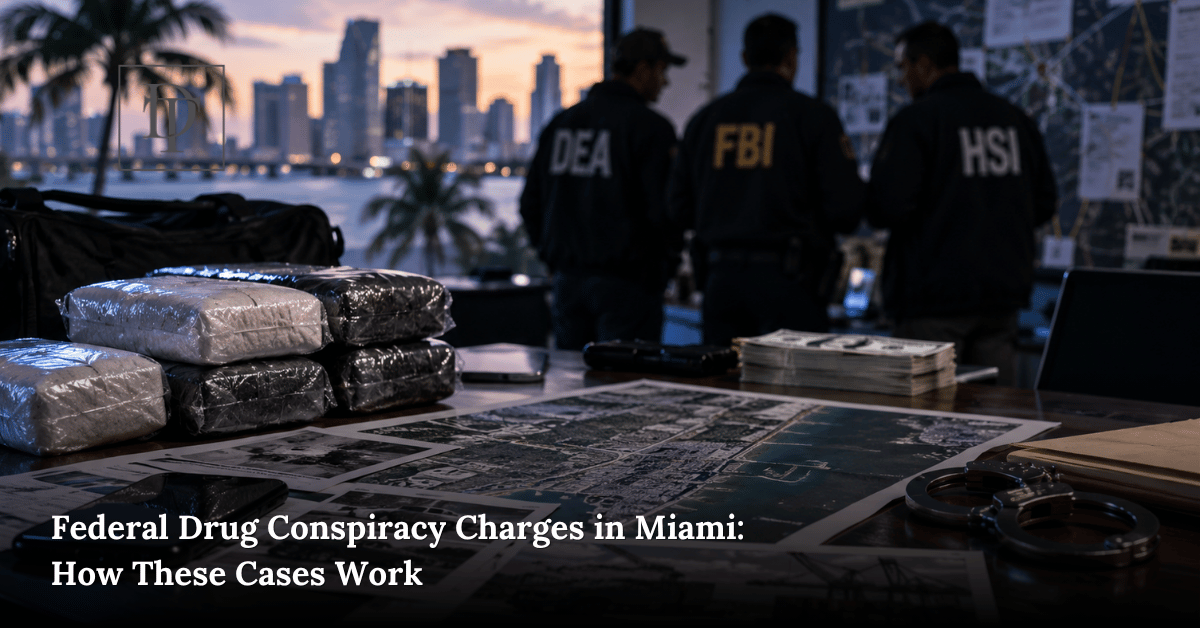
In Miami and throughout South Florida, these investigations may involve agencies such as the DEA, FBI, Homeland Security Investigations, U.S. Postal Inspection Service, or other federal and local law enforcement partners.
Understanding how these cases work requires looking beyond the moment of arrest. A federal drug conspiracy case can begin months or even years earlier and may involve an extensive investigation before a defendant ever learns that he or she is under scrutiny.
What Are Federal Drug Conspiracy Charges?
Federal drug conspiracy cases are commonly prosecuted under 21 U.S.C. §846.
The statute applies when prosecutors allege that two or more people agreed to commit a federal controlled-substance offense, such as distributing drugs or possessing controlled substances with intent to distribute.
Section 846 states that a person who attempts or conspires to commit an offense covered by the relevant federal drug laws is subject to the same penalties prescribed for the offense that was the object of the conspiracy.
That makes the conspiracy charge itself potentially extremely serious.
Unlike the general federal conspiracy statute under 18 U.S.C. §371, the Supreme Court has held that 21 U.S.C. §846 does not require prosecutors to prove an overt act in furtherance of the conspiracy. The alleged unlawful agreement and the defendant’s knowing participation are therefore central issues in these cases.
For a broader discussion of conspiracy law outside the narcotics context, see our guide to federal conspiracy charges.
What Must Federal Prosecutors Prove?
The current Eleventh Circuit criminal pattern jury instructions include a specific instruction for controlled-substance conspiracies prosecuted under 21 U.S.C. §846 and §963.
In general, a federal drug conspiracy prosecution centers on whether the government can prove beyond a reasonable doubt that:
- Two or more people agreed to pursue an unlawful drug-related objective.
- The defendant knew the unlawful purpose of that agreement.
- The defendant willfully joined the agreement.
- Where required for the charged offense and penalties, the government establishes the relevant controlled substance and drug quantity.
These questions can become complicated because conspiracy cases frequently depend on circumstantial evidence rather than a written or explicitly recorded agreement.
The Government Must Establish an Agreement
A conspiracy requires an agreement.
But prosecutors do not need to produce a signed contract stating that two people agreed to distribute narcotics.
Instead, they may attempt to infer an agreement from conduct.
Evidence might include:
- Repeated phone calls between alleged participants.
- Text or encrypted messages.
- Meetings immediately before or after alleged transactions.
- Money transfers.
- Travel records.
- Vehicle movements.
- Package shipments.
- Surveillance footage.
- Recorded conversations.
- Testimony from alleged co-conspirators.
- Drugs, cash, packaging equipment, or other physical evidence.
The prosecution may argue that these facts collectively demonstrate coordination toward a common unlawful objective.
The defense can challenge whether the evidence actually establishes a criminal agreement or whether prosecutors are assigning criminal meaning to relationships and conduct that have another explanation.
Knowledge Is Different From Association
Knowing someone who distributes drugs does not automatically make another person part of a drug conspiracy.
The prosecution must establish the defendant’s knowing and intentional participation.
That distinction can become especially important in federal investigations involving families, businesses, roommates, employees, friends, transportation providers, property owners, or people who regularly communicate with one another.
A person may know an alleged conspirator without knowing the purpose of a particular transaction.
Someone may also perform an act that appears suspicious after the fact but did not know that the larger activity involved controlled substances.
Federal drug conspiracy cases therefore often turn on what prosecutors can prove about the defendant’s state of mind, not simply who the person knew or where the person happened to be.
Federal Drug Conspiracy Does Not Require an Overt Act
One of the most important differences between a federal drug conspiracy prosecution and a general conspiracy prosecution involves the overt-act requirement.
Under 18 U.S.C. §371, the general federal conspiracy statute expressly requires an act to effect the object of the conspiracy.
Section 846 does not contain that requirement.
In United States v. Shabani, the U.S. Supreme Court held that the government is not required to prove an overt act to establish a drug conspiracy offense under §846.
That means prosecutors can potentially establish the offense based on the unlawful agreement and the defendant’s knowing participation without separately proving that a particular conspirator performed an additional overt act.
This is one of the reasons it is important not to treat all federal conspiracy charges as though they have identical elements.
How Does a Federal Drug Conspiracy Investigation Begin?
A defendant may enter the picture long after federal agents have begun investigating.
A case could initially develop through:
- A controlled purchase.
- A confidential informant.
- A traffic stop.
- A drug seizure.
- A package interception.
- A cooperating defendant in another prosecution.
- Financial activity.
- A search warrant.
- A wiretap.
- Electronic surveillance.
- Information obtained from another law enforcement agency.
Investigators may then work backward and outward from the original event.
A seized phone might identify additional contacts.
One contact might lead investigators to another phone.
Financial records may reveal payments between individuals.
Travel records might reveal repeated meetings or trips.
Agents may compare those events with known drug seizures or suspected transactions.
Over time, prosecutors may attempt to turn separate pieces of information into a single theory of conspiracy.
Our guide to how federal investigations work in Miami explains how federal agencies may develop a case before criminal charges are filed.
Why Federal Drug Conspiracy Cases Often Involve Many Defendants
Conspiracy law allows prosecutors to charge multiple alleged participants in a shared scheme.
As a result, federal drug indictments sometimes contain numerous defendants occupying very different alleged roles.
Prosecutors may characterize individuals as:
- Suppliers.
- Distributors.
- Couriers.
- Brokers.
- Customers purchasing redistribution quantities.
- Money handlers.
- Drivers.
- Organizers.
- Storage providers.
- Intermediaries.
But putting several defendants into one indictment does not by itself establish that every person knowingly joined the same conspiracy.
One issue the defense may examine is whether the evidence actually proves one common agreement or several separate relationships that prosecutors have grouped together.
That distinction can become important when someone had limited contact with only a small portion of the alleged network.
Do You Have to Personally Handle Drugs?
Not necessarily.
A defendant may face conspiracy allegations without personally possessing the drugs at the center of the case.
This issue is sufficiently important that we address it separately in our guide to drug conspiracy charges in Miami and how someone can be charged without handling drugs.
For purposes of this article, the more important point is that the government’s conspiracy theory typically focuses on whether the defendant knowingly joined the unlawful agreement, not simply whether drugs were found in his or her hands.
The absence of physical possession can still be highly relevant evidence, but it does not automatically end a §846 prosecution.
What Evidence Do Prosecutors Use in Federal Drug Conspiracy Cases?
Federal prosecutors may rely on a combination of direct and circumstantial evidence.
Often, no single item proves the government’s entire theory.
Instead, prosecutors try to connect multiple categories of evidence.
Phone Records and Text Messages
Phones can become central evidence in a narcotics investigation.
Investigators may examine:
- Call histories.
- Text messages.
- Encrypted communications.
- Contact lists.
- Photos.
- Location information.
- Deleted data.
- App activity.
The government may attempt to connect communications to particular meetings, transactions, seizures, or movements.
But messages can be ambiguous.
The defense may examine whether prosecutors are interpreting slang, abbreviated conversations, or ordinary communications in a way that the complete context does not support.
For more on this issue, see our article on digital evidence in criminal cases in Miami.
Cooperating Witnesses
Cooperating defendants and confidential sources can also play a major role.
Someone already facing federal charges may provide information about other alleged participants.
That testimony can be important to prosecutors because the witness may attempt to explain:
- Who was involved.
- What certain messages supposedly meant.
- Who supplied drugs.
- Who received money.
- How transactions were arranged.
- What role a particular defendant allegedly played.
But cooperation can create credibility issues.
A defense attorney may examine whether the witness expects a sentencing benefit, has made inconsistent statements, lacks firsthand knowledge, or has a reason to minimize his or her own conduct while shifting responsibility to someone else.
Surveillance
Physical and electronic surveillance may be used to connect individuals and events.
Agents may observe meetings, vehicles, residences, storage locations, ports, airports, or other locations.
But being present at a location does not necessarily prove the purpose of the meeting.
The government must connect that conduct to its broader conspiracy theory.
Financial Evidence
Drug conspiracy investigations may also involve:
- Cash deposits.
- Wire transfers.
- Payment apps.
- Cryptocurrency.
- Unexplained purchases.
- Business accounts.
- Money transfers between alleged participants.
Again, financial relationships are not automatically proof of drug trafficking.
The meaning of a transaction depends heavily on context.
Drug Quantity Can Dramatically Change the Case
Drug type and quantity can be crucial because federal narcotics penalties under 21 U.S.C. §841(b) vary substantially depending on the substance, quantity, prior qualifying convictions, and other circumstances.
Section 846 makes a person convicted of conspiracy subject to the same penalties prescribed for the underlying drug offense.
That means quantity can affect whether a case involves significant statutory minimum and maximum sentences.
For example, §841 establishes different penalty ranges depending on threshold quantities for controlled substances such as cocaine, heroin, fentanyl, methamphetamine, and others.
This makes an important question in many conspiracy cases:
How much of the alleged drug activity can legally be attributed to this particular defendant?
The answer may not always be identical to the total quantity attributed to the entire alleged conspiracy.
Is a Defendant Automatically Responsible for Every Drug in the Conspiracy?
This issue requires careful analysis.
Federal prosecutors may allege that a broad conspiracy handled a substantial amount of controlled substances.
But the government’s description of the entire organization does not necessarily resolve the quantity attributable to every individual defendant for every legal purpose.
Relevant questions may include:
- When did the defendant allegedly join?
- What did the defendant know?
- What was the scope of the criminal activity he or she allegedly agreed to undertake?
- Which transactions involved the defendant?
- What quantities can the government actually connect to the defendant?
- Are prosecutors relying primarily on estimates from cooperating witnesses?
- Are different transactions being combined correctly?
Drug quantity can affect both statutory exposure and sentencing calculations, making this an area that often deserves detailed scrutiny.
Federal Drug Conspiracy vs. Drug Trafficking
The terms are related but not identical.
A substantive drug trafficking charge may allege that a defendant knowingly manufactured, distributed, dispensed, or possessed a controlled substance with intent to distribute it under federal law.
A conspiracy charge focuses on the alleged agreement to commit an unlawful drug offense.
The government may charge both in the same indictment.
A defendant might therefore face one count alleging conspiracy and separate counts tied to particular alleged transactions.
For broader information about trafficking allegations, see our guide to drug trafficking charges in Miami.
If the dispute involves drugs allegedly found somewhere other than directly on the defendant, our article about constructive possession in Miami drug trafficking cases addresses that separate issue.
How Federal Prosecutors May Use One Defendant Against Another
Multi-defendant conspiracy cases create a powerful investigative dynamic.
Federal investigators may approach one alleged participant and ask that person to cooperate against others.
A defendant may provide:
- Recorded calls.
- Text messages.
- Introductions to undercover agents.
- Information about prior transactions.
- Testimony before a grand jury.
- Testimony at trial.
That can create a chain reaction.
One arrest may generate evidence against another person, which may lead to another interview or search warrant.
This is one reason federal conspiracy investigations can expand significantly after the first arrests become public.
What Is a Federal Drug Conspiracy Indictment?
An indictment is the formal charging document returned by a federal grand jury.
In a drug conspiracy case, it may identify:
- The applicable federal statutes.
- The approximate time period of the alleged conspiracy.
- The controlled substance involved.
- The alleged objective of the conspiracy.
- Drug quantities where relevant.
- Named defendants.
- Additional substantive charges.
An indictment does not establish guilt.
The prosecution must still prove the charged offense beyond a reasonable doubt.
If someone learns of the investigation through a subpoena before an indictment, our guide to federal grand jury subpoenas in Miami explains that earlier stage of the process.
What Happens After an Arrest for Federal Drug Conspiracy?
After an arrest or voluntary surrender, a defendant generally enters the federal criminal process.
That may involve:
- An initial appearance.
- A determination regarding detention or release.
- Arraignment.
- Discovery.
- Review of electronic and physical evidence.
- Pretrial motions.
- Plea negotiations or trial preparation.
- Trial if the case is not otherwise resolved.
- Sentencing following a guilty plea or conviction.
Federal criminal cases operate differently from ordinary Florida state prosecutions.
Our guide to what to expect during a federal arrest in Miami provides a more detailed overview of the early stages.
Can Someone Be Detained While the Case Is Pending?
Pretrial release is determined separately from whether a defendant is ultimately guilty.
The federal court may evaluate factors involving flight risk, danger to the community, the nature of the charge, criminal history, personal circumstances, and other considerations permitted by federal law.
Drug cases carrying significant potential penalties can create serious detention issues.
This means the defense strategy may begin immediately after arrest rather than waiting for the evidence-review stage.
How Sentencing Works in a Federal Drug Conspiracy Case
Federal sentencing can be complex.
There may be several different layers to consider:
- The statutory penalty range.
- Any applicable mandatory minimum.
- Drug type.
- Drug quantity.
- Prior qualifying convictions.
- The defendant’s role.
- Criminal history.
- Relevant conduct.
- Acceptance of responsibility where applicable.
- Other adjustments under the Federal Sentencing Guidelines.
Because §846 generally subjects the defendant to the penalties for the underlying controlled-substance offense, sentencing exposure may be closely tied to §841.
A large conspiracy indictment may describe extensive criminal activity, but that does not mean every sentencing issue is automatically resolved simply because the government alleges it.
Drug quantity, role, scope of participation, and other facts may remain contested.
For a broader explanation, see our guide to the federal sentencing guidelines in Miami.
Potential Issues in Defending Federal Drug Conspiracy Charges
Every federal drug case is different, and defenses depend on the evidence.
However, several recurring issues may need to be investigated.
No Agreement
The government may have evidence of communication or association but insufficient evidence that the defendant actually agreed to participate in drug trafficking.
Lack of Knowledge
The defendant may have participated in some activity without knowing that its purpose involved controlled substances.
Mere Association
Friendship, family relationships, business dealings, or repeated contact with an alleged conspirator do not by themselves establish knowing membership in a drug conspiracy.
Buyer-Seller Issues
In some cases, an important question may be whether the evidence establishes participation in a broader distribution conspiracy rather than only a buyer-seller relationship.
The analysis is highly fact-specific and can depend on the nature, frequency, quantity, credit arrangements, communications, and surrounding circumstances.
Unreliable Cooperating Witnesses
A significant portion of the government’s case may depend on people who have their own criminal exposure and possible incentives to cooperate.
Disputed Drug Quantity
The defense may challenge how prosecutors calculated quantities or whether specific transactions should be attributed to the defendant.
Multiple Conspiracies
The government may characterize several separate arrangements as one broad conspiracy.
Whether the evidence actually establishes the conspiracy charged can become a significant trial issue.
Illegal Search or Seizure
If evidence was obtained through a search, traffic stop, phone extraction, warrant, or other law enforcement action, counsel may examine whether constitutional violations create grounds for suppression.
Our guide to illegal search and seizure in Miami addresses this issue separately.
What If Federal Agents Contact You Before Charges Are Filed?
Not every person contacted during a conspiracy investigation has already been indicted.
Federal agents may attempt to interview individuals while determining whether they are witnesses, subjects, potential cooperators, or targets.
The way someone responds during this stage can matter.
A person may not know:
- What evidence agents already possess.
- What another alleged participant has told investigators.
- Whether calls have been recorded.
- Whether prosecutors have obtained financial records.
- Whether a grand jury is already involved.
- Whether investigators view the person as a witness or potential defendant.
Before agreeing to an interview or attempting to explain the situation, it can be important to understand your legal position.
Our guide explains the distinction between being a target, subject, or witness in a federal investigation.
Why Miami Federal Drug Conspiracy Cases Can Become Complex
South Florida federal drug prosecutions can involve activity extending far beyond Miami-Dade County.
Investigations may involve:
- Interstate transportation.
- International shipments.
- Airports.
- Seaports.
- Package delivery services.
- Financial transactions.
- Multiple jurisdictions.
- Numerous law enforcement agencies.
A defendant’s alleged role may represent only a small part of a much larger investigation.
For example, prosecutors may allege a distribution network involving South Florida while evidence comes from other states or countries.
That can produce enormous amounts of discovery, including phone extractions, surveillance records, financial data, recorded conversations, witness statements, and reports from multiple agencies.
The defense must often determine which evidence actually relates to the individual defendant rather than simply accepting the government’s description of the overall investigation.
Federal Drug Conspiracy Charges Require an Individualized Defense
A conspiracy indictment can make every defendant appear to be part of one unified organization.
The evidence may tell a more complicated story.
A meaningful defense analysis should examine the individual’s actual conduct:
- Who did the person communicate with?
- What was actually said?
- What did the person know?
- When did the person allegedly join?
- What transactions can be connected to that person?
- What evidence depends on cooperating witnesses?
- What quantity is being attributed to the defendant?
- What searches produced the government’s evidence?
- Does the evidence show one conspiracy or several?
- Does it show an agreement at all?
The answers can materially change how the case should be approached.
Facing Federal Drug Conspiracy Charges in Miami?

Federal drug conspiracy cases can be among the most serious narcotics prosecutions handled in federal court.
Under 21 U.S.C. §846, the government may prosecute an alleged agreement to violate federal drug laws without having to prove an overt act, and the statute exposes a convicted defendant to the penalties applicable to the underlying drug offense.
But an indictment is not proof of guilt.
Prosecutors still must prove the required elements beyond a reasonable doubt and establish that the individual defendant knowingly and intentionally joined the unlawful agreement.
If you have been contacted by federal agents, received a target letter or grand jury subpoena, or have already been arrested or indicted, obtaining legal advice early can help you understand the government’s allegations before making decisions that affect your case.
The Law Office of Dustin Tischler, P.A. represents individuals facing federal investigations and serious criminal charges in Miami, Miami-Dade County, and throughout South Florida.
Contact Dustin Tischler Law to discuss your case and evaluate the government’s evidence, the allegations against you, and the available defense options.