What Happens After You Receive a Federal Target Letter?
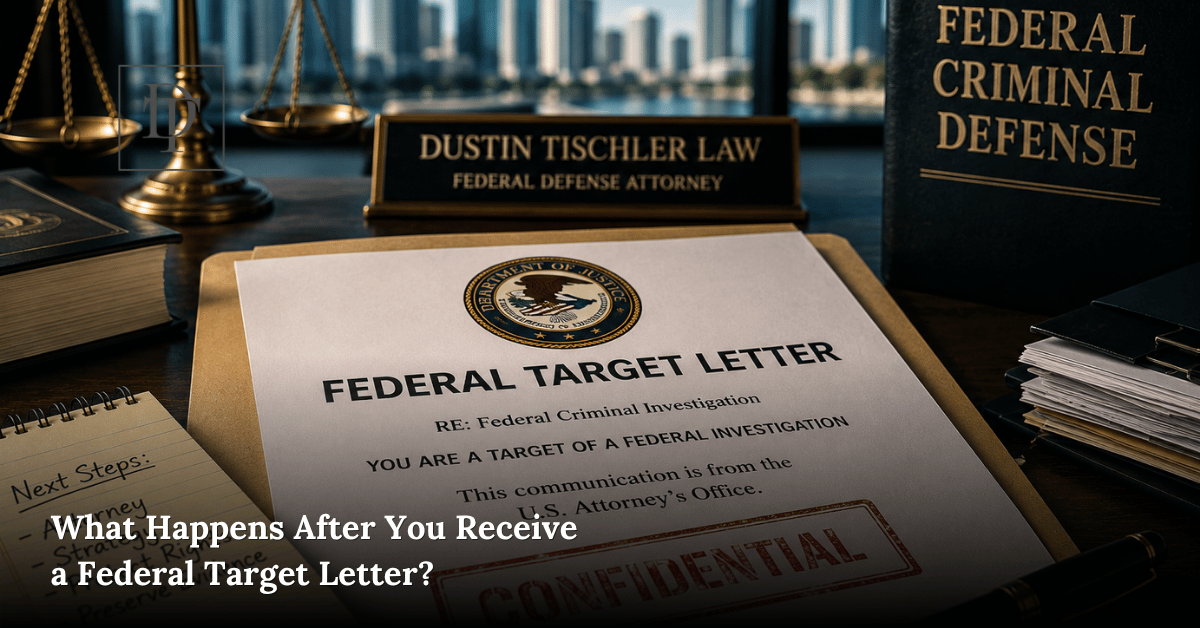
A federal target letter Miami recipient should take the letter seriously from the moment it arrives. A target letter usually means federal prosecutors believe your conduct is under investigation and that you may be more than a witness. It does not mean you have been convicted, and it does not always mean charges have already been filed, but it is a warning that the federal government is looking closely at you.
The Department of Justice describes a “target” as a person for whom prosecutors or the grand jury have substantial evidence linking them to the commission of a crime and who, in the prosecutor’s judgment, is a putative defendant. The Justice Manual also distinguishes a target from a “subject,” whose conduct is within the scope of the grand jury’s investigation.
At Dustin Tischler Law, we represent clients facing white collar crime charges in Miami, federal investigations, subpoenas, and serious criminal allegations involving fraud, money laundering, healthcare, business records, conspiracy, and related offenses.
Federal Target Letter Miami: What Does It Mean?
A federal target letter Miami investigation may involve the U.S. Attorney’s Office, a federal grand jury, and agencies such as the FBI, DEA, IRS, HHS-OIG, Homeland Security Investigations, or other federal authorities.
A target letter may tell you that:
- You are a target of a federal investigation
- A grand jury is investigating possible federal crimes
- You may be asked to testify or produce documents
- You have the right to remain silent
- You have the right to speak with an attorney
- Anything you say may be used against you
- Destroying, altering, or hiding documents can create additional legal problems
The DOJ’s sample target letter advises recipients that the grand jury is investigating possible violations of federal criminal law and warns that destruction or alteration of documents required before the grand jury can violate federal law, including obstruction of justice.
A target letter is not something to answer casually. It is often a sign that prosecutors are already evaluating whether to seek an indictment.
Target, Subject, or Witness: Why the Difference Matters
In federal investigations, people are often described as witnesses, subjects, or targets.
A witness may have information relevant to the investigation.
A subject is someone whose conduct is within the scope of the investigation.
A target is more serious. It generally means prosecutors believe there is substantial evidence linking that person to a crime and that the person may become a defendant.
This distinction matters because a target faces greater criminal exposure. If you receive a target letter, you should not assume you are simply being asked to “help” the investigation. Prosecutors may already be building a case.
Why Federal Prosecutors Send Target Letters
Federal prosecutors may send a target letter before asking someone to appear before a grand jury, before seeking an indictment, or during a broader investigation.
The DOJ’s grand jury guidance states that a grand jury may subpoena a subject or target of an investigation and question that person about involvement in the crime under investigation. The Justice Manual also discusses advice of rights for targets and subjects in grand jury matters.
A target letter may appear in cases involving:
- Wire fraud
- Mail fraud
- Healthcare fraud
- Medicare billing investigations
- Money laundering
- Bank fraud
- Tax-related allegations
- Federal drug conspiracies
- RICO or conspiracy investigations
- Cybercrime
- Public corruption
- Business or corporate investigations
If the letter relates to financial records, company accounts, billing, investments, or alleged fraud, the case may also overlap with federal fraud and white collar defense in Miami.
What You Should Not Do After Receiving a Target Letter
The first mistake many people make is trying to explain the situation directly to investigators. That can be risky. Even if you believe you did nothing wrong, a statement made without preparation can be misunderstood, contradicted by records, or used later by prosecutors.
After receiving a federal target letter, avoid:
- Calling the prosecutor yourself
- Speaking to agents without an attorney
- Destroying emails, messages, files, or business records
- Editing invoices, ledgers, or documents
- Contacting witnesses or co-defendants
- Posting about the investigation online
- Asking employees or associates to “clean up” records
- Ignoring the letter because no arrest has happened yet
A target letter is often the point where the defense should begin immediately. Waiting can give the government more time to shape the case without your side being properly evaluated.
What an Attorney May Do After a Target Letter
A defense attorney’s first job is to understand the nature of the investigation and prevent avoidable mistakes.
Depending on the case, defense counsel may:
- Contact the prosecutor on your behalf
- Clarify whether you are a target, subject, or witness
- Identify the statutes or allegations being investigated
- Review subpoenas or document requests
- Preserve relevant records
- Assess criminal exposure
- Evaluate whether testimony should be avoided
- Investigate facts before charges are filed
- Prepare a response strategy
- Negotiate with prosecutors when appropriate
In some cases, the goal may be to prevent charges. In others, the focus may be limiting exposure, preparing for indictment, challenging evidence, or developing mitigation early.
Does a Target Letter Mean You Will Be Indicted?
No. A target letter does not automatically mean you will be indicted. However, it does mean the situation is serious.
Federal prosecutors may still be reviewing documents, interviewing witnesses, presenting evidence to a grand jury, or deciding whether to file charges. In some cases, defense counsel may be able to present information that changes how prosecutors view the case. In other cases, the target letter may be a warning that indictment is likely.
If an indictment or arrest follows, the case may move quickly into the federal court process. The DOJ explains that after a federal arrest and charge, a defendant is usually brought before a magistrate judge for an initial hearing, where rights, attorney representation, detention, or release may be addressed.
If your target letter later leads to an arrest, the defense may connect with federal criminal defense in Miami.
Digital Records and Financial Evidence in Target Letter Cases
Federal target letters often appear in document-heavy investigations. Prosecutors may already have emails, bank records, phone data, business records, invoices, patient files, tax documents, crypto transactions, or communications from other witnesses.
Evidence may include:
- Emails and text messages
- Bank statements
- Wire transfers
- Business records
- Billing files
- Contracts and invoices
- Phone extractions
- Cloud storage
- Social media messages
- Accounting software
- Search warrant materials
- Subpoenaed records
If the investigation involves phones, accounts, messages, or electronic records, the defense may need to examine digital evidence in criminal cases.
The defense should not only ask what records exist. It should ask what those records actually prove, whether they are complete, whether they are being interpreted correctly, and whether they show criminal intent.
Target Letters in RICO, Conspiracy, and Fraud Investigations
Federal target letters are common in complex investigations where prosecutors believe multiple people, companies, accounts, or transactions may be connected.
In a RICO or conspiracy investigation, prosecutors may use a target letter to notify someone that their conduct is being examined as part of a broader theory. That theory may involve alleged agreements, financial transactions, communications, predicate acts, or enterprise activity.
If prosecutors are trying to connect you to a broader group or alleged criminal scheme, the case may involve RICO and conspiracy defense in Miami.
The defense may challenge whether you actually agreed to join unlawful conduct, knowingly participated, controlled the relevant accounts, or understood the alleged purpose of the activity.
Should You Testify Before the Grand Jury?
A target letter may be connected to a grand jury subpoena. Whether a target should testify is a major decision that should not be made without legal advice.
Testifying may create risks because statements can be used against the person later. Refusing to testify or invoking constitutional rights may also require careful handling. The DOJ’s grand jury guidance recognizes that targets may be subpoenaed and questioned, and it discusses advice of rights in that context.
Before deciding what to do, a defense attorney may need to review:
- The subpoena
- The subject matter of the investigation
- The potential charges
- The client’s exposure
- The documents requested
- Prior statements
- Whether immunity is being discussed
- Whether testimony could increase risk
This is not a decision to make alone.
Federal Target Letter Investigations in Miami
Federal target letters in Miami are often connected to investigations handled by the U.S. Attorney’s Office for the Southern District of Florida, federal grand juries, and agencies such as the FBI, IRS, DEA, HHS-OIG, or Homeland Security Investigations.
Because many target letters involve subpoenas, records requests, financial documents, digital evidence, or possible grand jury proceedings, location can matter. Clients in Miami may need to respond quickly to federal prosecutors, preserve records, and prepare for the possibility of an indictment, arrest, or initial appearance in federal court.
Dustin Tischler Law is located in Downtown Miami and represents clients facing federal investigations, target letters, subpoenas, white collar allegations, RICO matters, fraud investigations, and serious criminal charges throughout Miami-Dade County.
Speak With a Miami Federal Defense Attorney

Receiving a federal target letter in Miami means the government may already be reviewing your conduct, records, communications, or business activity. Because federal investigations can move quickly, early legal guidance can help protect your rights before prosecutors decide whether to seek charges.
Dustin Tischler Law represents clients facing federal investigations, target letters, subpoenas, fraud allegations, RICO and conspiracy matters, white collar cases, and serious criminal charges in Miami and throughout South Florida.
If you received a federal target letter, contact Dustin Tischler Law as soon as possible to discuss your situation and begin preparing a defense strategy.