A New Anti-Fraud Task Force Is Taking Shape in Miami. Here’s What It Could Mean
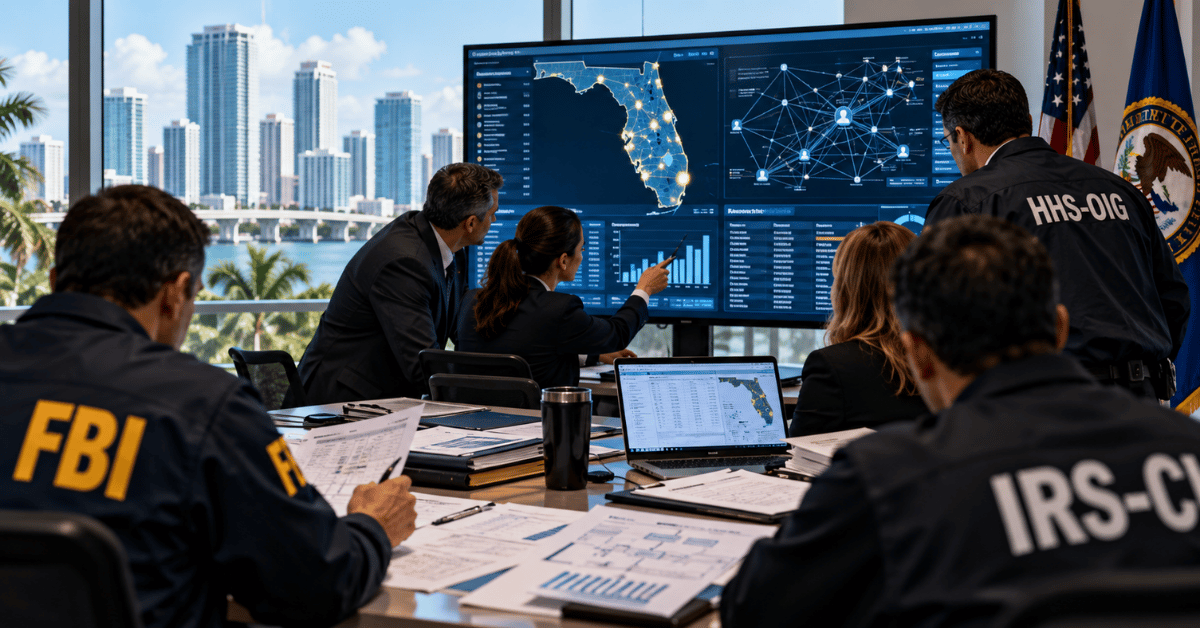
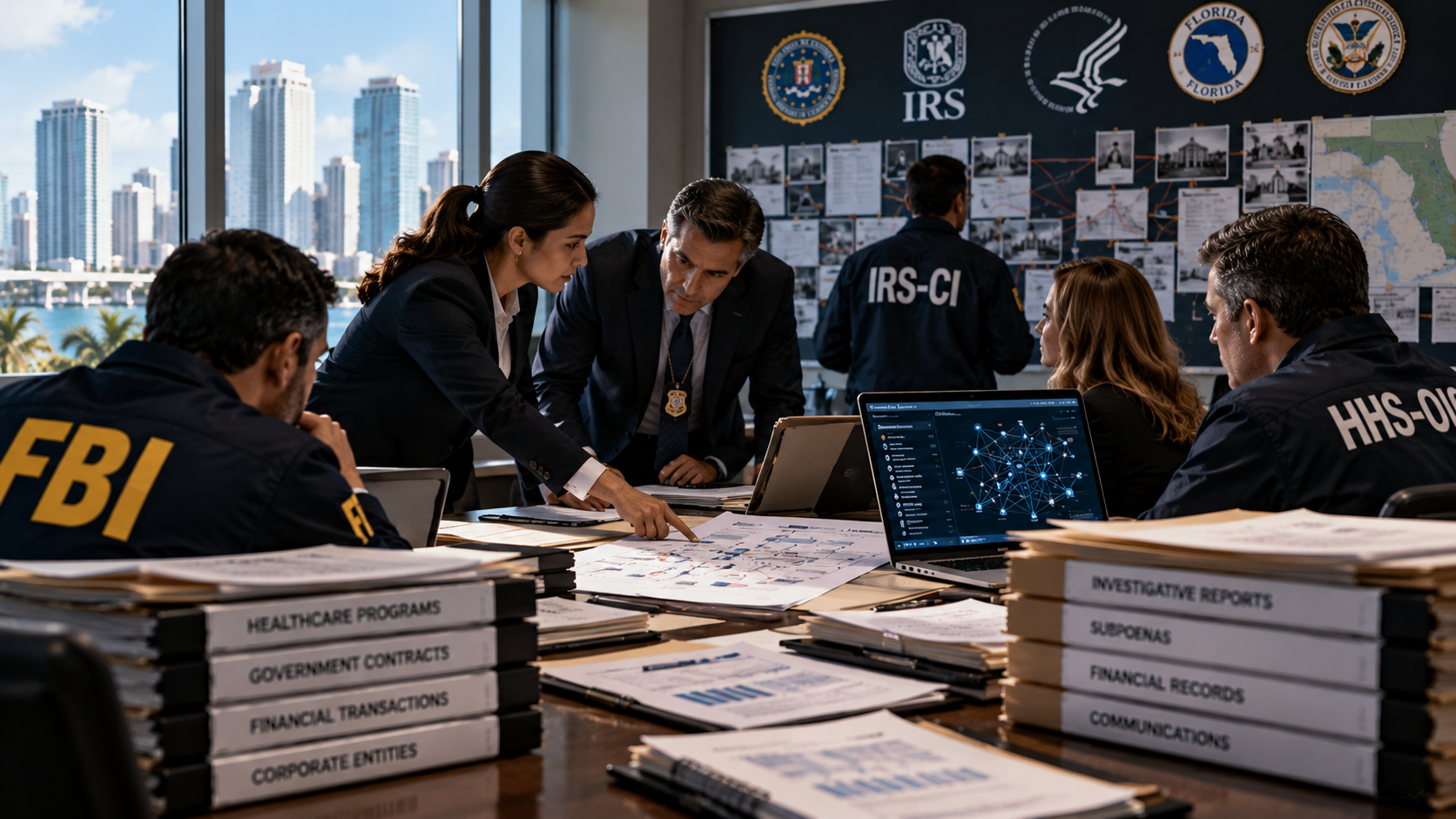
Federal and state enforcement leaders have launched a new Florida Anti-Fraud Task Force designed to bring prosecutors, investigators, inspectors general, and government data together to identify fraud involving taxpayer-funded programs.
The task force held its inaugural meeting in Miami on September 9, 2026.
What makes the announcement noteworthy is not simply the creation of another enforcement group.
The initiative is designed to increase cooperation across agencies that previously may have held different pieces of information about the same individuals, businesses, payments, or government programs.
For businesses, healthcare providers, professionals, and others in South Florida, that raises an important question:
What could more coordinated, data-driven fraud enforcement mean for future federal investigations?
What Is the New Florida Anti-Fraud Task Force?
According to the U.S. Attorney’s Office for the Southern District of Florida, the Florida Anti-Fraud Task Force was created to improve federal-state cooperation in detecting, investigating, and prosecuting fraud involving federal government benefit programs.
The inaugural meeting brought together an unusually broad group of enforcement authorities.
Participants included federal prosecutors from Florida’s Southern, Middle, and Northern Districts, the Florida Attorney General’s Office, and representatives from agencies including:
- FBI
- IRS Criminal Investigation
- HHS Office of Inspector General
- Florida Department of Law Enforcement
- Florida Agency for Health Care Administration
- Florida Medicaid Fraud Control Unit
- Department of Labor OIG
- Small Business Administration OIG
- Department of Veterans Affairs OIG
- Homeland Security OIG
- Miami-Dade Office of Inspector General
- Broward Sheriff’s Office
- Palm Beach County Office of Inspector General
And those are only some of the participating agencies.
The significance is not necessarily that these agencies suddenly gained new investigative powers.
Many already investigate fraud within their respective jurisdictions.
The important development is the effort to connect their information, resources, and investigative capabilities more closely.
Why Data Sharing May Be the Most Important Part of the Announcement

Fraud investigations increasingly involve enormous amounts of information.
A single investigation can potentially touch corporate registrations, bank transactions, healthcare claims, government payments, addresses, business relationships, electronic communications, and records maintained by different government agencies.
Historically, one challenge for investigators has been that relevant information may exist in separate systems.
The Justice Department says the new initiative is intended to reduce those information gaps.
The Florida task force will work with the DOJ’s National Fraud Detection Center, a prosecutor-led, multi-agency initiative created to identify suspicious activity across federal programs.
Florida has also entered data-sharing arrangements that provide federal fraud investigators access to certain corporate registration and public-benefits payment information.
That matters because investigators may increasingly be able to identify connections and patterns across different datasets rather than examining a single transaction or program in isolation.
What Could Data-Driven Fraud Enforcement Look For?
The creation of the task force does not mean that a particular transaction, billing discrepancy, or business relationship is evidence of a crime.
Data can identify patterns.
It does not, by itself, establish criminal intent.
However, coordinated analysis could potentially help investigators identify relationships that warrant further examination.
Depending on the program and circumstances, those could include:
- Multiple businesses connected through common owners or addresses
- Unusual government billing or payment patterns
- Relationships between providers, suppliers, and marketers
- Payments appearing across different government programs
- Corporate entities associated with the same individuals
- Transactions that appear inconsistent with underlying services
- Repeated activity involving businesses already under scrutiny
A data-generated lead may be only the beginning.
Investigators still need evidence capable of establishing the elements of a criminal offense.
But the ability to compare information across agencies can influence where an investigation starts and what investigators examine next.
More Agencies Can Mean a Broader Investigation
Another important feature of the Florida Anti-Fraud Task Force is its composition.
A case involving healthcare billing, for example, could potentially generate records relevant to HHS-OIG, the FBI, federal prosecutors, Florida healthcare regulators, and financial investigators.
A government-contracting matter could involve a completely different combination of agencies.
The task force is intended to make collaboration across those institutional boundaries easier.
That can matter when investigators believe conduct extends beyond one company, one transaction, or even one government program.
Records collected for one investigative purpose may reveal relationships that prompt additional questions.
Financial transactions may lead to corporate records.
Corporate records may identify additional businesses.
Business relationships may lead investigators to communications, contracts, or other individuals.
The investigation can consequently become broader than the issue that initially attracted government attention.
Does a Data Match Prove Fraud?
No.
This distinction is particularly important.
Government databases can identify correlations, anomalies, or patterns that investigators consider unusual.
But unusual activity is not automatically criminal activity.
Federal fraud cases generally require proof of fraudulent intent or other elements established by the specific statute being charged.
There can be legitimate explanations for unusual billing patterns, shared business addresses, corporate relationships, financial transfers, or discrepancies in government records.
The government’s interpretation of data can therefore become an important issue in a fraud investigation.
Investigators may see a pattern.
The defense may need to determine whether the underlying records actually support the conclusion investigators are drawing from it.
South Florida Is Already a Major Federal Fraud Enforcement Environment
The new task force is not starting from zero.
South Florida already has extensive federal fraud enforcement infrastructure, particularly in healthcare and financial crime cases.
The region is served by the U.S. Attorney’s Office for the Southern District of Florida and numerous federal investigative agencies.
Existing initiatives include healthcare fraud strike forces and partnerships among federal prosecutors, the FBI, HHS-OIG, Florida authorities, and other agencies.
Recent enforcement provides an example.
In September, two South Florida men were sentenced to federal prison in a $34.8 million Medicare fraud case involving durable medical equipment companies, allegedly fraudulent doctors’ orders, kickbacks, and medically unnecessary braces.
We recently examined what the $34.8M Medicare fraud case reveals about federal fraud prosecutions.
The new Florida Anti-Fraud Task Force potentially adds another layer of coordination to an enforcement environment that is already highly active.
What Happens When a Fraud Investigation Becomes Federal?
Not every fraud allegation becomes a federal criminal case.
Federal jurisdiction may arise when conduct involves federal programs, federal funds, interstate communications, financial institutions, federal agencies, or violations of federal criminal statutes.
Investigations can also involve both state and federal authorities.
That distinction becomes particularly relevant when agencies are deliberately working together.
A matter that initially appears connected to a state program or local business activity may reveal conduct investigators believe implicates federal law.
Likewise, information developed during a federal investigation may be relevant to state authorities.
For a broader explanation of jurisdiction, see our guide to when a crime becomes a federal offense in Miami.
What Could Trigger Contact From Federal Investigators?
People often imagine that a federal criminal case begins with an arrest.
Frequently, it does not.
Complex fraud investigations can develop for months before criminal charges are announced.
A business owner, healthcare provider, executive, employee, or other professional might first become aware of government scrutiny through:
- A subpoena for records
- A grand jury subpoena
- Contact from federal agents
- A request for an interview
- A search warrant
- A request for business or financial documents
- A government audit or payment suspension
- Contact involving another person or company under investigation
The meaning of that contact depends on the circumstances.
A person may be viewed as a witness, subject, or potential target, and that status can evolve as investigators obtain additional evidence.
Our guide to how federal investigations in Miami work explains how agencies such as the FBI and IRS can develop federal cases before charges are filed.
What the New Anti-Fraud Task Force Does — and Does Not — Tell Us
It is important not to overstate what has happened.
The creation of the Florida Anti-Fraud Task Force does not mean that every billing irregularity, government payment discrepancy, or unusual business relationship will lead to prosecution.
Nor does an investigative lead establish guilt.
What the announcement does show is where enforcement authorities are directing resources.
The Justice Department has explicitly emphasized:
data sharing, cross-agency cooperation, earlier fraud detection, and coordinated prosecution.
Those priorities can affect how future investigations are identified and developed.
For someone who becomes the subject of that scrutiny, the legal questions remain much more specific:
What evidence does the government actually have?
What does the data show?
Is the government’s interpretation accurate?
Can prosecutors prove knowledge and criminal intent?
And what role, if any, did the person actually play in the conduct being investigated?
Why the Florida Anti-Fraud Task Force Matters in Miami
Miami was chosen for the inaugural meeting of a task force intended to coordinate fraud enforcement throughout Florida.
For South Florida businesses and professionals, the most important part of the announcement may ultimately be what happens behind the scenes.
Investigators from different agencies increasingly have tools for connecting information that previously existed in separate government systems.
That could help authorities identify potential cases earlier and investigate relationships across businesses, payments, individuals, and government programs.
But data is still evidence that must be interpreted.
A suspicious pattern is not the same as proof of a federal crime.
As enforcement becomes more coordinated and data-driven, understanding exactly what investigators believe the records show may become an increasingly important part of defending complex fraud cases.
Sources
U.S. Attorney’s Office, Southern District of Florida — Florida Enforcement Leaders Hold Inaugural Meeting of the Florida Anti-Fraud Task Force to Enhance Federal-State Cooperation to Detect, Investigate, and Prosecute Fraud, September 9, 2026.
U.S. Department of Justice — National Fraud Detection Center and related federal-state data-sharing initiatives described in the September 9, 2026 announcement.
This article is based on publicly available government information and is provided for general informational purposes. The creation of an investigative task force does not establish wrongdoing by any individual or business, and every criminal case depends on its specific facts and evidence
Facing a Fraud Investigation in Miami?
If you have received a federal subpoena, been contacted by investigators, learned that business or financial records are being reviewed, or are facing allegations involving fraud, the stage at which you seek legal advice can matter.
Dustin Tischler Law represents professionals, executives, business owners, and individuals facing white collar and fraud investigations in Miami and South Florida, including complex matters involving federal agencies, financial records, healthcare fraud, and alleged fraudulent schemes.
Contact Dustin Tischler Law to discuss your situation.