A Former Congressman Was Sentenced to 10 Years in Miami. Here’s Where Money Laundering Entered the Case
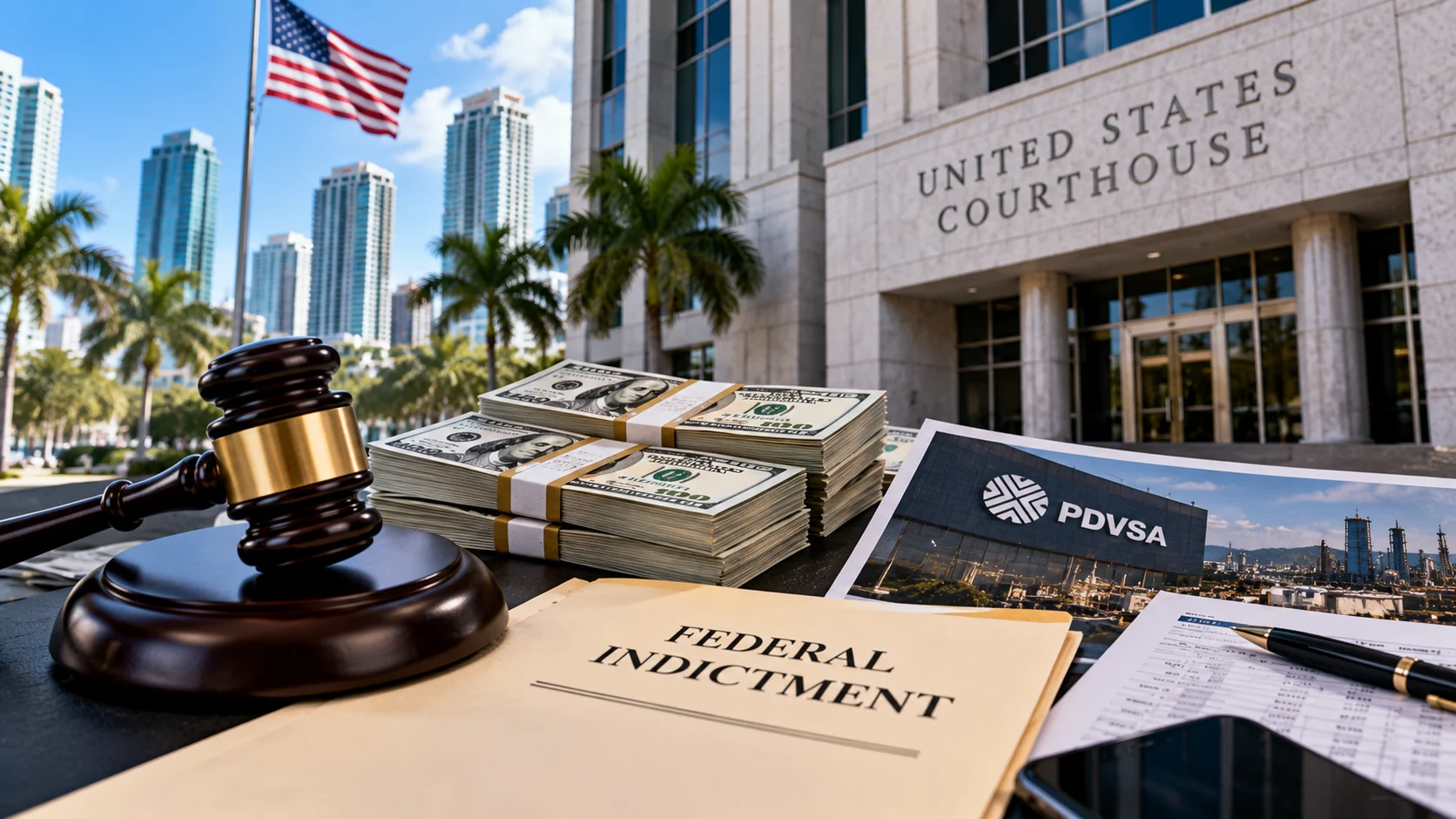
Former U.S. Congressman David Rivera was sentenced to 10 years in federal prison in Miami on October 2, 2026, after a jury convicted him in a case involving undisclosed work for the Venezuelan government and millions of dollars connected to that activity.
The case attracted attention because of Rivera’s political background and the allegations involving Venezuela.
But another part of the prosecution deserves a closer look:
Money laundering.
Rivera was not convicted only of violating federal foreign-agent registration laws.
The jury also convicted him of conspiracy to commit money laundering and four counts involving transactions in criminally derived property.
That raises a broader question that extends beyond this particular prosecution:
How does money laundering become part of a federal case when the underlying allegations involve an entirely different type of conduct?
What Happened in the David Rivera Money Laundering Case?
According to the U.S. Attorney’s Office for the Southern District of Florida, Rivera and co-defendant Esther Nuhfer obtained a $50 million contract with a subsidiary of Petróleos de Venezuela, S.A., commonly known as PDVSA.
Federal prosecutors argued that the purpose of the arrangement was to advance the interests of the Venezuelan government in the United States.
The government’s evidence showed that Rivera and Nuhfer engaged in lobbying activity without registering as foreign agents as required under the Foreign Agents Registration Act, or FARA.
According to the Justice Department, their activities included lobbying U.S. officials and arranging meetings involving American policymakers and senior Venezuelan officials.
A federal jury ultimately convicted Rivera of:
Conspiracy to violate FARA
Violating FARA
Conspiracy to commit money laundering
Four counts of engaging in transactions in criminally derived property
U.S. District Judge Melissa Damian sentenced Rivera to 10 years in federal prison.
Nuhfer was separately sentenced to five years after being convicted of FARA violations, money laundering conspiracy, and engaging in a transaction involving criminally derived property.
The Money Laundering Charges Were Not Separate From the Larger Story
Money laundering is sometimes imagined as a standalone crime involving hidden cash, offshore accounts, or elaborate attempts to disguise the ownership of illegal proceeds.
Federal cases can be considerably more complicated.
A money laundering charge can develop from financial transactions connected to another alleged federal offense.
That is important in the Rivera case.
The government’s theory connected the financial transactions to the underlying conduct involving undisclosed foreign-agent activity.
According to evidence presented at trial, money from the PDVSA-related contract did not simply remain in one account.
Prosecutors traced how portions of those proceeds were subsequently used.
The Justice Department stated after sentencing that Rivera deposited approximately $1.5 million in proceeds from the contract into his Florida state congressional campaign account between March 2017 and August 2018, among other personal uses.
Nuhfer used approximately $455,000 in proceeds to purchase a residence in Key Colony Beach.
Those transactions became part of the financial evidence presented in the broader federal prosecution.
Following the Money Can Connect Different Parts of a Federal Case

One of the most significant aspects of complex financial investigations is that prosecutors do not necessarily examine transactions in isolation.
They reconstruct the movement of money.
That can mean examining:
Where funds originated
Which accounts received them
Who controlled those accounts
How money moved between entities
What funds were ultimately used to purchase
Whether financial transactions corresponded with communications or other activity
Whether defendants knew the source or nature of the funds
Whether transactions were intended to promote or conceal unlawful conduct
In Rivera’s case, IRS Criminal Investigation participated alongside the FBI.
After sentencing, IRS-CI specifically emphasized its role in tracing illicit funds and protecting the integrity of the U.S. financial system.
This illustrates why financial records can become central evidence even when the original investigation involves conduct that does not initially appear to be a traditional financial crime.
Money Laundering Does Not Require the Underlying Crime to Be Financial Fraud
This is an important distinction.
Money laundering charges are not limited to cases in which the original alleged offense was fraud.
Federal prosecutors pursue money laundering in cases involving many different categories of criminal activity.
The financial transaction becomes relevant because prosecutors allege that the money represents proceeds of specified unlawful activity or that a transaction involving those proceeds satisfies the requirements of the applicable federal money laundering statute.
That means an investigation can effectively contain two layers.
First, prosecutors attempt to establish the underlying criminal activity.
Then they examine what happened to money allegedly generated by or connected to that activity.
In some cases, the financial evidence may become almost as important as the evidence supporting the underlying offense.
For a broader explanation of how financial transactions can overlap with other federal allegations, see our guide to money laundering and RICO charges in Miami.
Why Conspiracy Matters in a Money Laundering Case
Rivera was convicted of conspiracy to commit money laundering.
That distinction matters.
A conspiracy charge allows prosecutors to focus not only on an individual financial transaction but also on an alleged agreement among participants.
In a federal conspiracy case, investigators may examine communications, business relationships, transfers, meetings, account activity, and other evidence to determine whether multiple people were knowingly participating in a common unlawful objective.
The government does not necessarily have to portray every participant as performing the same function.
One person might control an account.
Another might authorize a transaction.
Someone else might communicate with third parties.
Another participant may be connected to the underlying activity that allegedly generated the proceeds.
The legal question becomes whether prosecutors can establish the elements required for the specific conspiracy offense charged.
Our guide to federal conspiracy charges explains in greater detail how prosecutors use agreements, communications, financial transactions, and other evidence when building federal conspiracy cases.
Financial Records Can Tell Only Part of the Story
Following money can produce powerful evidence.
But a financial transaction does not explain itself.
Money routinely moves among businesses, political organizations, consultants, family members, investment accounts, vendors, and other entities for lawful reasons.
A bank transfer can establish that money moved from one place to another.
It does not necessarily establish why.
That distinction can become critical in a money laundering prosecution.
Depending on the statute charged, prosecutors may need to establish knowledge, intent, the criminal source of funds, or the purpose of particular transactions.
As a result, financial evidence is often examined alongside other evidence such as:
Emails
Text messages
Contracts
Invoices
Corporate records
Witness testimony
Account ownership records
Electronic communications
Recorded conversations
Evidence concerning the underlying alleged offense
The context surrounding the transaction can therefore become just as important as the transaction itself.

Coded Communications Can Become Part of the Government’s Theory
Another notable part of the Rivera prosecution involved communications.
According to the Justice Department, evidence at trial showed Rivera and Nuhfer using coded language in text messages when discussing their activities.
That type of evidence can become particularly important when prosecutors attempt to establish what defendants knew or intended.
A financial record may establish that a payment occurred.
A message sent before or after that payment may be used by prosecutors to argue what the payment represented.
A meeting may provide additional context.
Another transaction may appear to reinforce the alleged pattern.
Federal prosecutors can then attempt to combine those separate pieces into one narrative.
The defense, however, can examine whether the government’s interpretation accurately reflects the communications and transactions when viewed in their full context.
The $50 Million Contract and the Amount Actually Traced Are Different Questions
Large numbers naturally attract attention in federal prosecutions.
The contract involved in the Rivera case was worth $50 million.
That does not mean Rivera personally received $50 million.
Those are different facts.
The Justice Department described the $50 million as the value of the contract Rivera and Nuhfer obtained with a PDVSA subsidiary.
Separately, prosecutors presented evidence concerning particular proceeds and transactions tied to the defendants.
That distinction matters in any financial crime case.
The total value of a contract, business operation, alleged scheme, or series of transactions should not automatically be treated as the amount personally received, laundered, lost, or attributable to a particular defendant.
Understanding what each number actually represents can be essential when analyzing a federal financial prosecution.
Why IRS Criminal Investigation Was Involved
People frequently associate the IRS exclusively with tax cases.
Its criminal investigators have a much broader financial investigative role.
IRS Criminal Investigation regularly participates in cases involving money laundering and other financial crimes because its agents specialize in tracing funds and reconstructing complex financial activity.
The Rivera investigation involved both FBI Miami and IRS Criminal Investigation’s Florida Field Office.
That combination illustrates how federal investigations can bring together agencies with different areas of expertise.
The FBI may investigate conduct connected to national security, foreign influence, public corruption, fraud, or other federal offenses.
IRS-CI can follow the financial trail.
Federal prosecutors can then attempt to connect those different categories of evidence into the criminal charges presented to a grand jury and, ultimately, a trial jury.
For people who become involved in these investigations, the first indication of federal scrutiny may occur well before an indictment. Our guide to federal investigations in Miami explains how financial records, subpoenas, interviews, and investigative agencies can become part of a developing federal case.
South Florida Is a Major Environment for Money Laundering Enforcement
The Rivera prosecution also took place in a district where financial crime and money laundering receive substantial federal enforcement attention.
The U.S. Attorney’s Office for the Southern District of Florida maintains prosecutors focused specifically on money laundering and international financial crime.
South Florida’s financial institutions, real estate markets, international business connections, and position as a gateway between the United States, Latin America, and the Caribbean can make complex cross-border financial activity particularly significant to federal investigators.
That does not make international transactions suspicious by themselves.
Nor does moving substantial amounts of money establish money laundering.
The government must still prove the required elements of the charged offense.
But when federal investigators believe money is connected to criminal activity, tracing where those funds originated and where they ultimately went can become a major part of the investigation.
What the Rivera Case Shows About Federal Money Laundering Prosecutions
The Rivera case was unusual in several respects.
It involved a former member of Congress.
It involved Venezuela.
It involved foreign-agent registration laws.
And it involved a multimillion-dollar contract connected to a state-owned foreign company.
But one feature of the prosecution is relevant far beyond those circumstances:
Federal investigators followed the money alongside the underlying alleged conduct.
That allowed prosecutors to present the jury with more than one category of evidence.
The case involved lobbying activity.
It involved communications.
It involved relationships with foreign officials.
And it involved the movement and use of money connected to the government’s theory of the case.
Rivera’s conviction demonstrates how money laundering allegations can become an additional component of a federal prosecution even when financial crime is not necessarily the issue that first makes the case newsworthy.
A Money Laundering Investigation Can Become Broader Than a Single Transaction
Once federal investigators begin tracing money, the investigation may extend outward.
One account can identify another account.
A payment can identify a business.
A business can lead to corporate records.
Those records can identify additional people.
Communications can provide context for transactions.
Transactions can raise questions about other communications.
That is one reason complex money laundering investigations can generate large volumes of evidence.
For a defendant, business owner, executive, professional, or other person caught in such an investigation, one of the most important questions is not simply whether a transaction occurred.
The questions are more specific:
Where did the money come from?
What did the person know about its source?
Why was the transaction made?
What does the surrounding evidence actually establish?
And can prosecutors prove the required criminal intent beyond a reasonable doubt?
Those questions can determine whether financial activity is evidence of a federal crime or simply one part of a much more complicated factual record.
Sources
U.S. Attorney’s Office, Southern District of Florida — Former U.S. Congressman and Lobbyist Convicted of Acting as Unregistered Agents of Venezuela in Connection with $50 Million Contract, May 1, 2026.
This article is based on publicly available government and court information and is provided for general informational purposes.
Facing a Federal Money Laundering Investigation in Miami?

Money laundering investigations can involve bank records, corporate accounts, electronic communications, subpoenas, asset tracing, conspiracy allegations, and evidence connected to other alleged federal offenses.
Understanding the financial transaction is only part of the analysis.
The source of the money, the defendant’s knowledge, the purpose of the transaction, and the government’s interpretation of the surrounding evidence can all become important.
Dustin Tischler Law represents individuals, professionals, executives, and business owners facing white collar and fraud investigations in Miami and South Florida, including federal cases involving money laundering, financial records, conspiracy allegations, and complex government investigations.
If federal investigators have contacted you, served a subpoena, frozen assets, requested financial records, or you believe you may be the subject of a money laundering investigation, obtaining legal advice early can help you understand what the government may be investigating and protect your rights.
Contact Dustin Tischler Law to discuss your situation.