Digital Evidence in Criminal Cases Miami: How Investigators Use Your Phone & Social Media
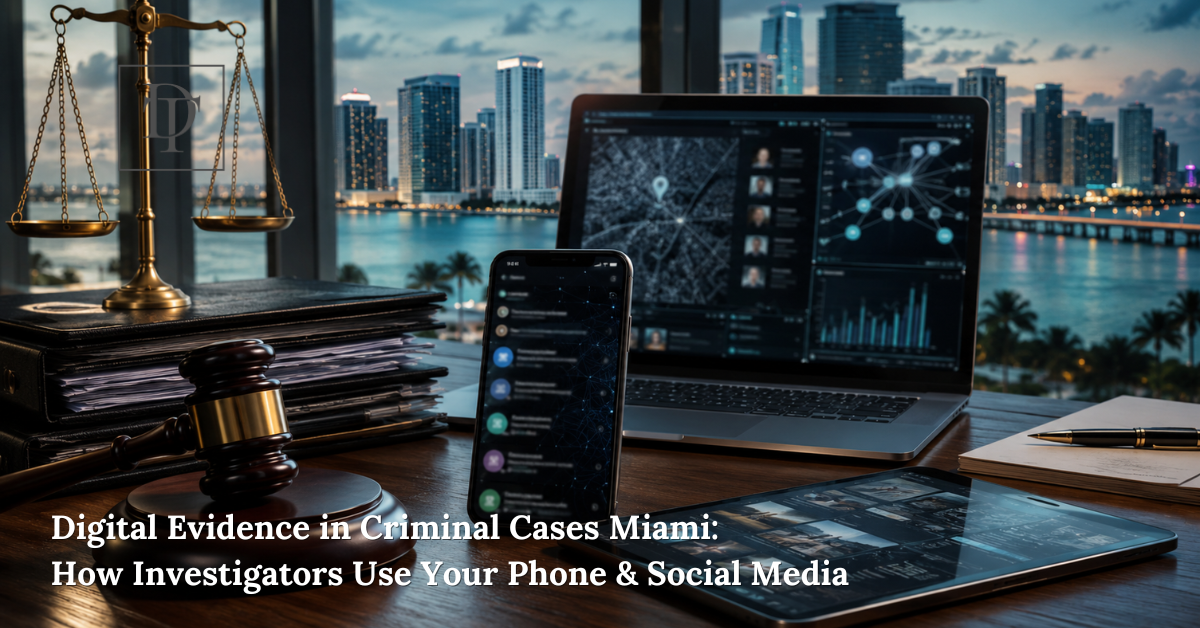
Digital evidence in criminal cases Miami has become one of the most important parts of modern criminal investigations. A phone, social media account, text message, location record, photo, video, or online search can become part of the evidence prosecutors use to build a case.
For many people, this evidence feels personal because it often comes from everyday life: a message sent to a friend, a social media post, a GPS record, a deleted photo, or a conversation in an app. But once investigators believe digital records are connected to a criminal accusation, that information may become a central part of the case.
At Dustin Tischler Law, we defend clients facing criminal charges in Miami by reviewing how digital evidence was collected, whether law enforcement followed the law, and whether the evidence actually proves what prosecutors claim.
Digital Evidence in Criminal Cases Miami: What Can Investigators Use?
In a Miami criminal case, digital evidence can come from many sources. Investigators may look at a person’s phone, social media activity, email, cloud storage, location history, browser activity, photos, videos, app data, or messages.
Common examples include:
- Text messages
- Call logs
- Social media posts
- Direct messages
- Photos and videos
- GPS and location history
- Search history
- Email records
- Cloud backups
- Deleted files
- App activity
- Metadata from images or files
- Phone extraction reports
- Security camera footage
- Ride-share or delivery app records
This type of evidence may appear in cases involving drugs, firearms, theft, robbery, fraud, domestic violence, cybercrime, white collar allegations, or violent crime accusations.
If the case involves online accounts, computer activity, electronic communications, or digital records, the defense may also overlap with cybercrime charges in Miami.
Can Police Search Your Phone After an Arrest?
A phone is not treated like an ordinary item in your pocket. The U.S. Supreme Court held in Riley v. California that police generally may not search digital information on a cell phone seized during an arrest without a warrant.
That matters because a phone can contain years of private information: messages, photos, videos, contacts, notes, banking apps, health data, location records, and cloud-connected accounts.
However, that does not mean phone evidence can never be used. Investigators may seek a search warrant, subpoena certain records, or use other lawful methods to obtain digital evidence. The defense must review whether law enforcement had proper legal authority, whether the search stayed within the scope of the warrant, and whether any evidence was collected improperly.
How Social Media Can Become Evidence
Social media is often used in criminal investigations because it can show what a person posted, where they were, who they contacted, or what they appeared to know at a certain time.
Investigators may review:
- Public posts
- Stories or reels
- Direct messages
- Tagged photos
- Comments
- Account connections
- Location tags
- Time stamps
- Deleted or archived content
- Photos showing objects, vehicles, locations, or people
In some cases, prosecutors may try to use social media to suggest motive, intent, association, location, or involvement. But social media evidence can be misleading. A post may be taken out of context. A photo may be old. A message may be a joke, exaggeration, or unrelated conversation. An account may be shared, hacked, or accessed by someone else.
That is why the defense should not only ask what the post says. It should ask who created it, when it was created, whether it was edited, whether it was preserved correctly, and whether the prosecution can prove it means what they claim.
Location Data and Phone Records
Location data can be powerful, but it is not always as precise as prosecutors may suggest.
Investigators may use:
- Cell tower records
- GPS data
- App location data
- Google or Apple account records
- Ride-share records
- Wi-Fi connections
- Bluetooth connections
- License plate readers
- Security footage matched with phone data
The U.S. Supreme Court held in Carpenter v. United States that the government generally needs a warrant supported by probable cause to obtain historical cell-site location information.
For the defense, location evidence must be reviewed carefully. A phone being near a location does not always prove the owner committed a crime. A device may be borrowed, left somewhere, carried by another person, or connected to a broad geographic area rather than a specific address.
Digital Evidence Can Be Misinterpreted
Digital evidence may look objective, but it still requires interpretation. A message, photo, location ping, or deleted file does not always tell the full story.
Problems may include:
- Missing context
- Incorrect timestamps
- Shared devices
- Shared passwords
- Auto-syncing between devices
- Cloud backups from old data
- Edited screenshots
- Incomplete message threads
- Misread slang or emojis
- Data connected to the wrong user
- Metadata that does not prove what prosecutors claim
For example, a message may look suspicious when isolated, but the full conversation may show something different. A social media post may appear recent, but the photo may have been taken months earlier. A deleted file may not prove guilt; it may have been removed automatically or as part of normal phone usage.
A strong defense examines the entire digital trail, not just the part prosecutors highlight.
Digital Evidence in Drug, Fraud, and Violent Crime Cases
Digital evidence can appear in many types of Miami criminal cases.
In drug cases, prosecutors may rely on messages, call logs, location data, or alleged coded language. If your case involves narcotics allegations, the digital evidence may need to be reviewed alongside drug crimes in Miami defense issues.
In fraud or financial cases, investigators may review emails, bank records, online accounts, invoices, payment apps, IP addresses, or business communications. These cases may also connect with white collar crime charges in Miami.
In violent crime cases, prosecutors may look at videos, photos, messages, social media activity, location records, or communications before and after the alleged incident. This may overlap with violent crime charges in Miami.
How a Defense Attorney Challenges Digital Evidence
Challenging digital evidence requires more than reading screenshots. The defense must review how the evidence was found, collected, stored, extracted, and interpreted.
A defense strategy may examine:
- Whether police had a valid warrant
- Whether the warrant was too broad
- Whether investigators searched beyond the warrant’s scope
- Whether the phone extraction was reliable
- Whether screenshots were altered or incomplete
- Whether the account actually belonged to the accused
- Whether someone else had access to the device
- Whether timestamps and metadata are accurate
- Whether the chain of custody was preserved
- Whether the evidence is being taken out of context
In some cases, the defense may seek to suppress evidence that was obtained unlawfully. In other cases, the defense may challenge the meaning, reliability, or relevance of the evidence.
What Not to Do If Police Ask About Your Phone or Social Media
If police want to talk about your phone, messages, social media accounts, or online activity, do not assume you can explain everything informally.
You should avoid:
- Giving consent to search your phone without legal advice
- Sharing passwords with investigators without speaking to an attorney
- Deleting messages, photos, posts, or accounts
- Contacting witnesses or co-defendants online
- Posting about the case
- Trying to “clear things up” through text or social media
- Assuming deleted data cannot be recovered
Deleting content after an investigation begins can create additional legal problems. The better approach is to preserve evidence and speak with a defense attorney before responding to law enforcement questions.
Speak With a Miami Criminal Defense Attorney

Digital evidence can shape the direction of a criminal case, but it does not always tell the full story. A phone record, social media post, or location ping may raise questions, but the prosecution still has to prove its case with reliable evidence.
Dustin Tischler Law helps clients in Miami challenge digital evidence, review search issues, and build defense strategies based on the facts. If your phone, social media accounts, messages, or online activity are part of a criminal investigation, legal guidance should begin as early as possible.
Contact Dustin Tischler Law today to discuss your case and protect your rights.